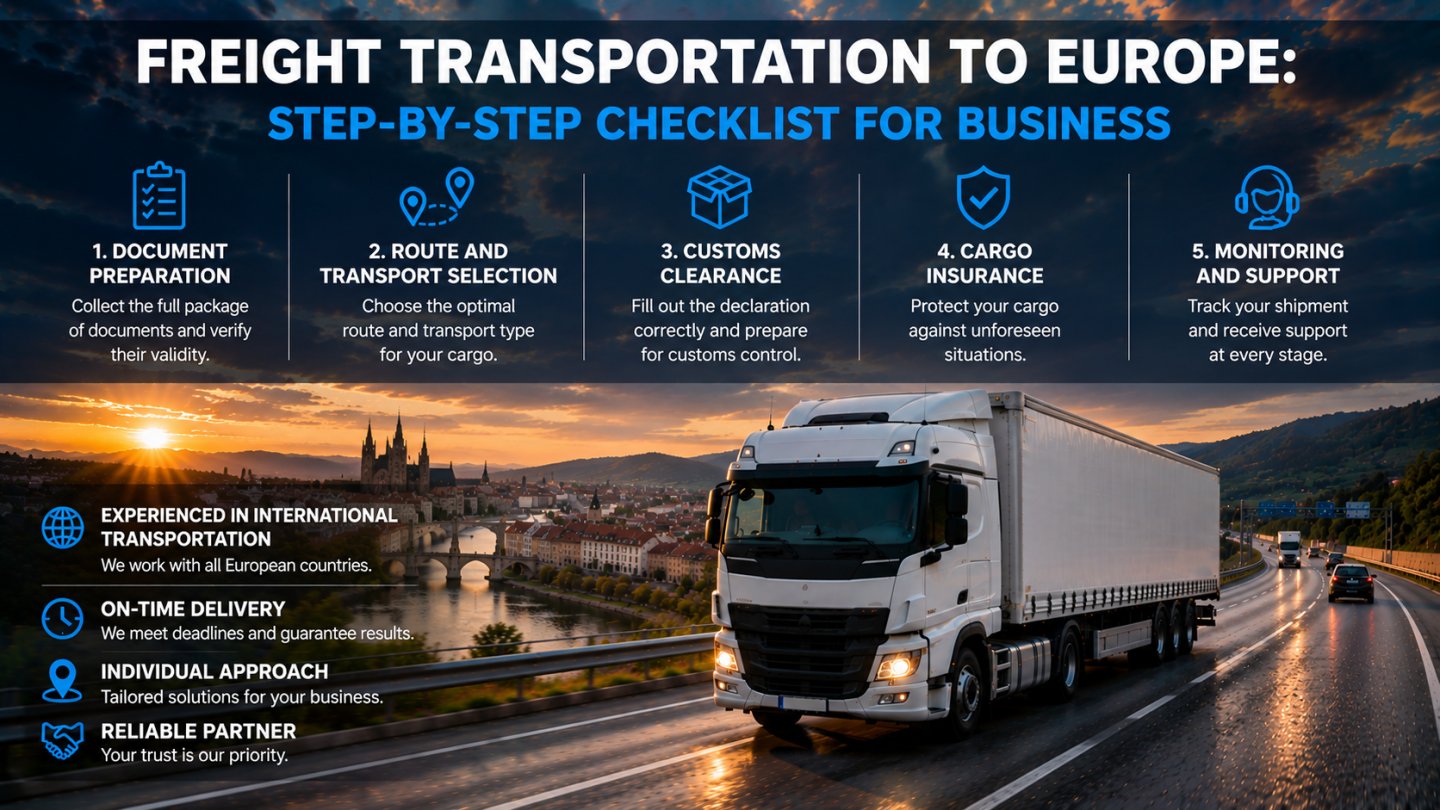
Shipping Cargo to Europe: A Step-by-Step Organisation Checklist
Checklist: 5 steps before your first trip to Europe
Shipping to Europe begins long before a truck pulls up for loading. Here is the checklist we advise every client to run through before starting:
● Define the product category, weight, and dimensions
● Check destination-country requirements and permits
● Choose the transport type: FTL, LTL, or reefer
● Prepare documents and choose the Incoterms term
● Arrange cargo insurance
Practical tip. Do not try to cover several countries at once. Pick one direction, work out the logistics and documents on it, and only then scale up. Our experience of more than 27,000 trips a year shows a phased launch is cheaper than a chaotic start on all fronts.
Steps 1-2: goods and destination requirements
Dual-use goods, food, and chemicals (ADR — dangerous goods) carry separate rules. Not knowing them costs money. We start with a consultation: the client describes the cargo, and our specialists immediately flag which documents and transport are needed. This is part of our logistics consulting.
In our experience, the most problems arise not with exotic but with ordinary cargo, when the shipper assumes "this is simple." It is exactly on such batches that code and certificate errors happen. So we advise a consultation even for a typical product.
Step 3: matching transport to the cargo
|
Transport type |
What it is for |
|
Curtain-side (FTL) |
General cargo, full truckload |
|
Groupage (LTL) |
Small batches, cargo consolidation |
|
Reefer |
Food, medicine with temperature control |
|
Special platform |
Heavy machinery, oversized loads with permits |
Choosing the wrong transport type can wreck the whole trip. An our own fleet of 87 long-haul tractors gives us the flexibility to assign exactly the vehicle the job needs.
Important to know. Modern tractors meeting emission standards enter low-emission zones in EU cities freely, while older trucks can face a ban or a fine. An updated fleet is a real route advantage, not just comfort.
Steps 4-5: documents, route, and insurance
The best route is not always the shortest. Crossing congestion, waiting times, truck restrictions, and even winter weather on mountain passes all affect the schedule. We plan the route around the real situation at the borders.
Insurance covers the risk of damage or loss. An international home-appliance manufacturer we serve ships batches worth hundreds of thousands of euros, and insurance here is settled at the contract level. More on responsible storage and warehouse services during consolidation separately.
Seasonal peaks deserve separate planning. Before holidays and at quarter-end, demand for transport rises, trucks are full, and timelines stretch. If your delivery schedule allows, shipping off-peak saves both money and nerves.
Make life easier
The simplest path is to hand logistics to a company that owns the whole cycle: consultation, documents, delivery, and customs clearance. Then the business focuses on sales rather than border queues. That is the advantage of a end-to-end operator in international logistics.
In February 2026, an equipment web store shipped its first groupage batch to the Czech Republic. We recommended LTL over a dedicated run — nearly halving the cost. Compare the formats yourself: regional and last-mile delivery in the service pages.
FAQ — Frequently Asked Questions
What do I need for a first trip to Europe?
Run the checklist: product category, destination requirements, transport type, documents with the Incoterms term, and insurance.
What is ADR?
It is the international agreement on the transport of dangerous goods. Such cargo requires special approval for the vehicle and driver. Which transport should I choose for food?
A reefer with temperature control, which holds the required temperature throughout the trip.
Can oversized cargo be shipped?
Yes, it needs a special platform and route permits. We organise such transport.
Why insure the cargo?
Cargo crosses several borders and spends days on the road — insurance covers the risk of damage or loss.