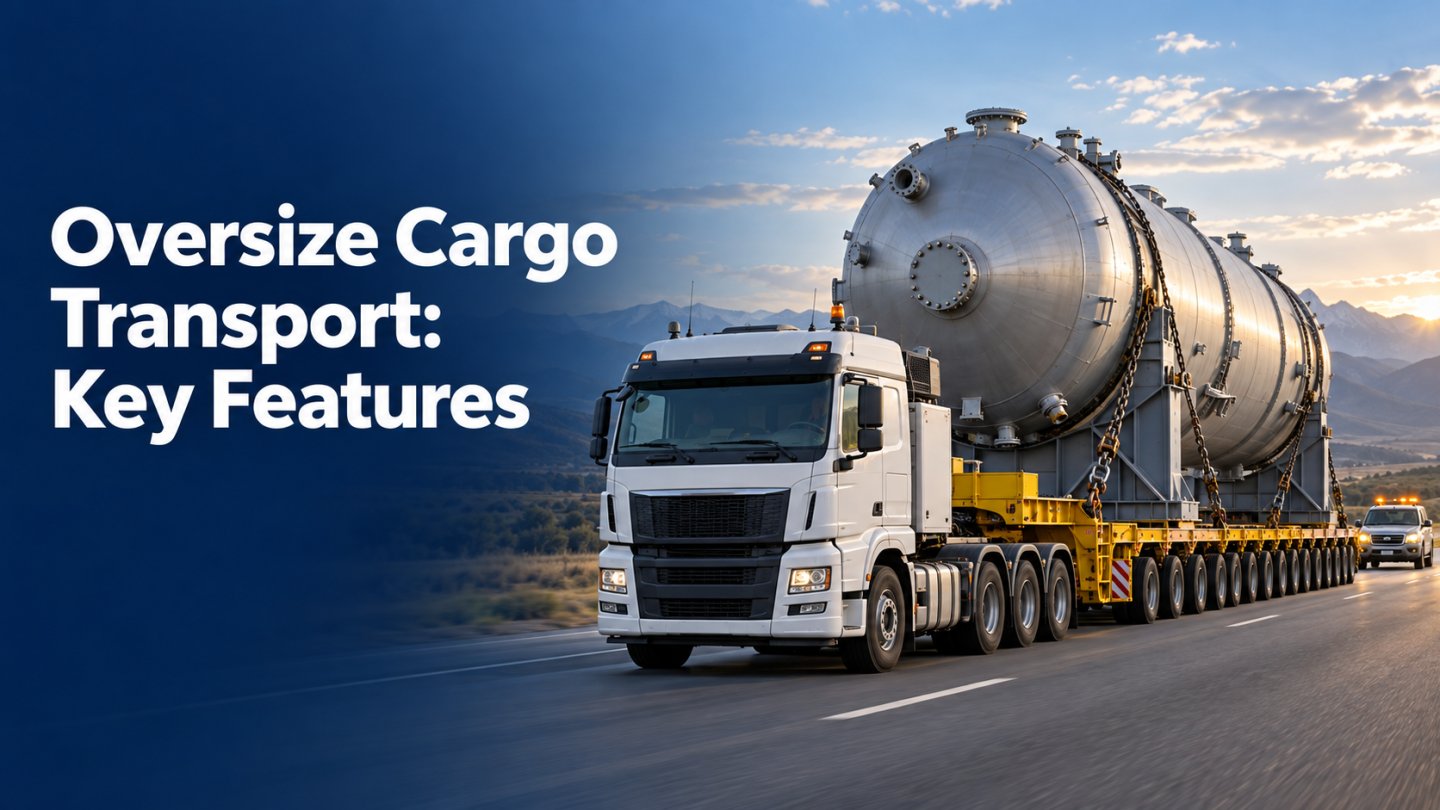
Oversize Cargo Transport: Key Features
Oversize cargo isn't just "something big." Equipment, metal structures, special machinery and industrial units exceed standard dimensions or weight, and their transport follows separate rules. A mistake here is costly — from a fine to cargo damage. Let's look at the features of such shipments.
When cargo is considered oversize
Cargo enters the oversize category when it exceeds permitted limits on at least one parameter — width, height, length or weight including the vehicle. Even a few centimetres can change the category.
Specialised equipment
Oversize cargo requires special transport:
● Low-loaders and low-bed platforms — for tall and heavy cargo.
● Extendable trailers — for long loads such as beams or pipes.
● Multi-axle platforms — to distribute heavy weight.
Route planning
An oversize route is planned separately — the shortest path isn't always passable. Bridges with limits, power lines, interchanges and turning radii are all considered. Sometimes a longer but safe path must be chosen. This is part of the work on line-haul transportation.
Key point: oversize doesn't tolerate improvisation. The route is calculated to the centimetre before departure.
Permits and escort
Moving oversize cargo requires permits and, where needed, escort. This adds preparation time, so such shipments are planned in advance. The operator handles permit paperwork.
Securing and safety
Oversize cargo has a special centre of gravity, so standard securing schemes don't fit. Proper fastening ensures the cargo arrives intact. Insurance is an essential element.
A real example
In January 2026, a company needed to move large industrial equipment as part of a production upgrade. We selected a low-bed trailer, obtained the permits and planned a route bypassing two restricted sections. The cargo arrived undamaged and exactly within the window agreed with the installation crew.
«Oversize is always a bespoke project. Here the winner is the one who calculates every detail in advance.» — Head of special transportation, Pakline Group
Frequently asked questions
How long does preparation take?
It depends on complexity: obtaining permits and agreeing the route take time. That's why oversize shipments are planned in advance.
Is insurance mandatory?
Yes. Oversize equipment is usually high-value, so insurance protects the business from risks in transit.
Planning around installation
Oversize cargo is often equipment installed on site immediately. So the delivery time must align with the installation crew's schedule: too early and the cargo takes up space and needs storage; too late and the crew stands idle. An experienced operator synchronises delivery with installation, arriving exactly within the set window. This coordination is especially valuable for industrial projects, where every day of equipment downtime is costly.
Key takeaways
● Logistics is designed per shipment — there are no one-size-fits-all solutions;
● Documents and preparation matter as much as the transport itself;
● A reliable partner with its own infrastructure removes the main risks from the business.
Pakline Group has the equipment and experience for complex cargo. Over 20 years on the market and ISO certifications. Discuss oversize transport on the transportation page.