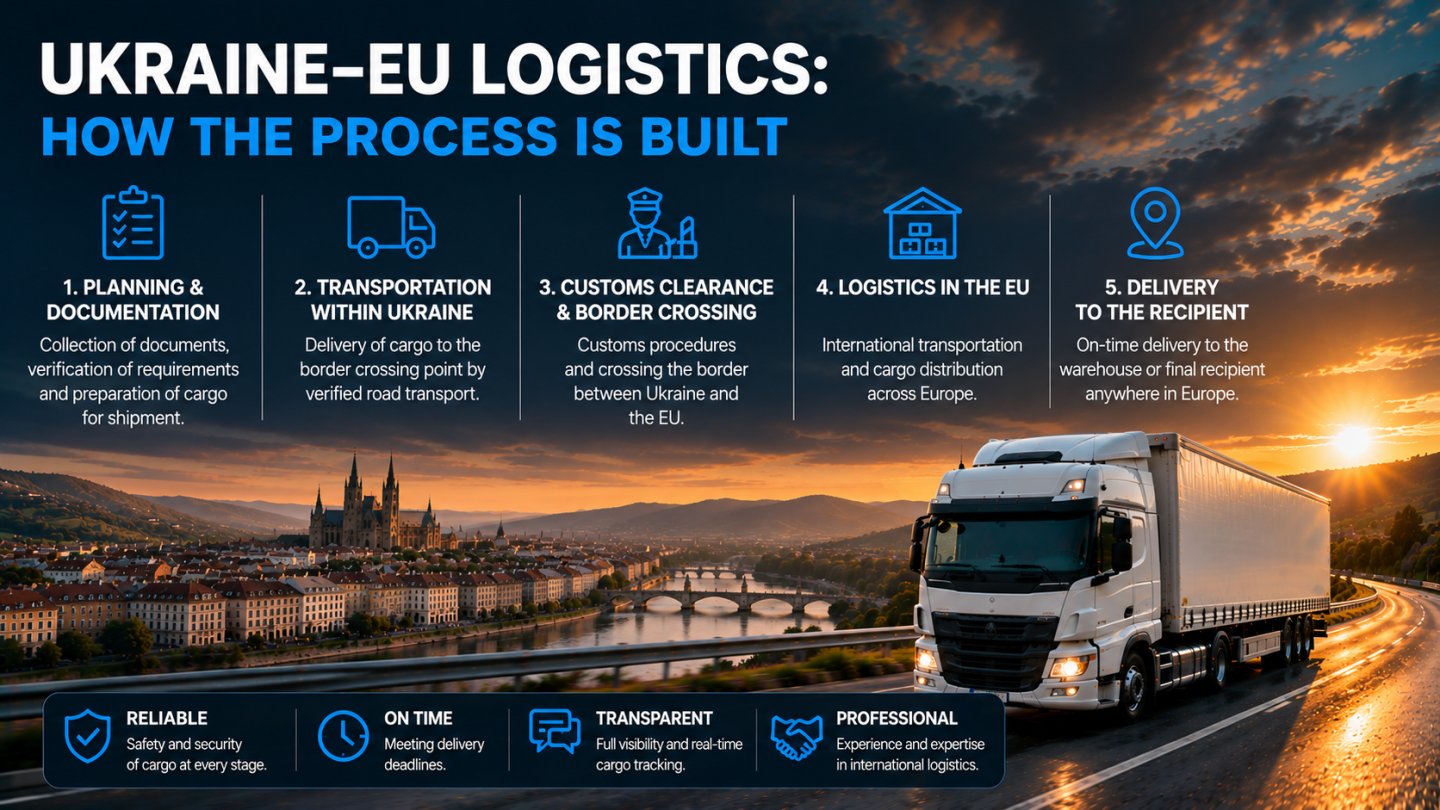
Ukraine–EU Logistics: How the Process Works Step by Step
Why EU logistics is harder than domestic
Inside Ukraine, cargo moves without borders or customs. With the EU come customs clearance, different rules in each country, language nuances in the paperwork, and control at the crossings. Every stage can slow delivery if no one manages it. Let us break the whole chain down as a a practical walkthrough.
The language and human factor adds complexity too. Documents in different countries may need translation, and any miscommunication drags the process out. A company that has worked a direction for years knows these nuances and does not step on the same rakes twice.
Stages of cargo movement: the instruction
● Pickup from the client's warehouse with our transport
● Preparing and checking documents (CMR, invoice, declaration)
● Export customs clearance leaving Ukraine
● Border control and crossing
● Movement to the EU destination
● Import clearance in the destination country
● Last-mile delivery to the final recipient
An our own last-mile fleet of 158 units lets us deliver not only to a warehouse but directly to the recipient in the destination city. More on freight from Ukraine in the service description.
Where time and money leak most
Common mistake. The biggest losses are idle time at the border over documents and cutting corners on insurance, which becomes heavy losses the moment something goes wrong. Another is a lack of transparency: when the client cannot see where the cargo is, they cannot react in time.
We close these risks systematically: documents are prepared in advance, the route is planned around the real situation, the cargo is insured, and status is visible in real time. That is why on-time performance holds at 99%.
Another underrated loss is the absence of a single point of responsibility. When several subcontractors run the logistics, no one owns a problem because everyone points at someone else. A full-cycle operator removes this entirely.
The role of warehouse infrastructure
|
Warehouse function |
What the business gains |
|
Cargo consolidation |
Full-load dispatch, lower per-unit cost |
|
Storage |
Buffer between production and dispatch |
|
Repacking |
Compliance with EU labelling requirements |
|
Quality control |
Check before departure, less border risk |
Pakline's own warehouses handle 675,000 m³ a year. A large home-appliance retailer accumulates goods at our warehouse and then ships to the EU in consolidated batches. More on warehouse services and responsible storage separately.
What the business gains
Well-run Ukraine–EU logistics means predictable timelines, transparent costs, and one accountable partner instead of a dozen subcontractors. There is no situation where no one owns a problem. Need help building a channel? We provide logistics consulting.
Case: 18% lower cost. Between January and June 2026, one furniture maker cut their EU delivery cost by 18% — through batch consolidation at our warehouse and planned return loads. As our logistics team says, "savings are born in route planning, not on the road." You'll find similar setups across our warehouse network.
Want to go deeper? Read our breakdown of how to cut freight costs — practical, numbers-based advice.
Combining owned transport and warehouses gives a closed cycle: intake, storage, consolidation, and delivery to the EU, all within one company. For the business, that means a predictability you cannot achieve by assembling a chain of random subcontractors.
FAQ — Frequently Asked Questions
How does export clearance differ from import clearance?
Export clearance is done leaving Ukraine; import clearance happens in the EU destination country. We handle both stages.
Why is a warehouse needed in international logistics?
For consolidating small batches, storage, repacking, and quality control before dispatch.
How long is the whole chain to the EU?
Depending on direction, 2–3 days (Poland) to 4–6 days (Western Europe) with ready documents.
Who is responsible for the cargo in transit?
A end-to-end operator is a single point of responsibility at every stage, with no shifting to subcontractors.
What is cargo consolidation?
Combining several small batches into one truck to lower the per-unit delivery cost.