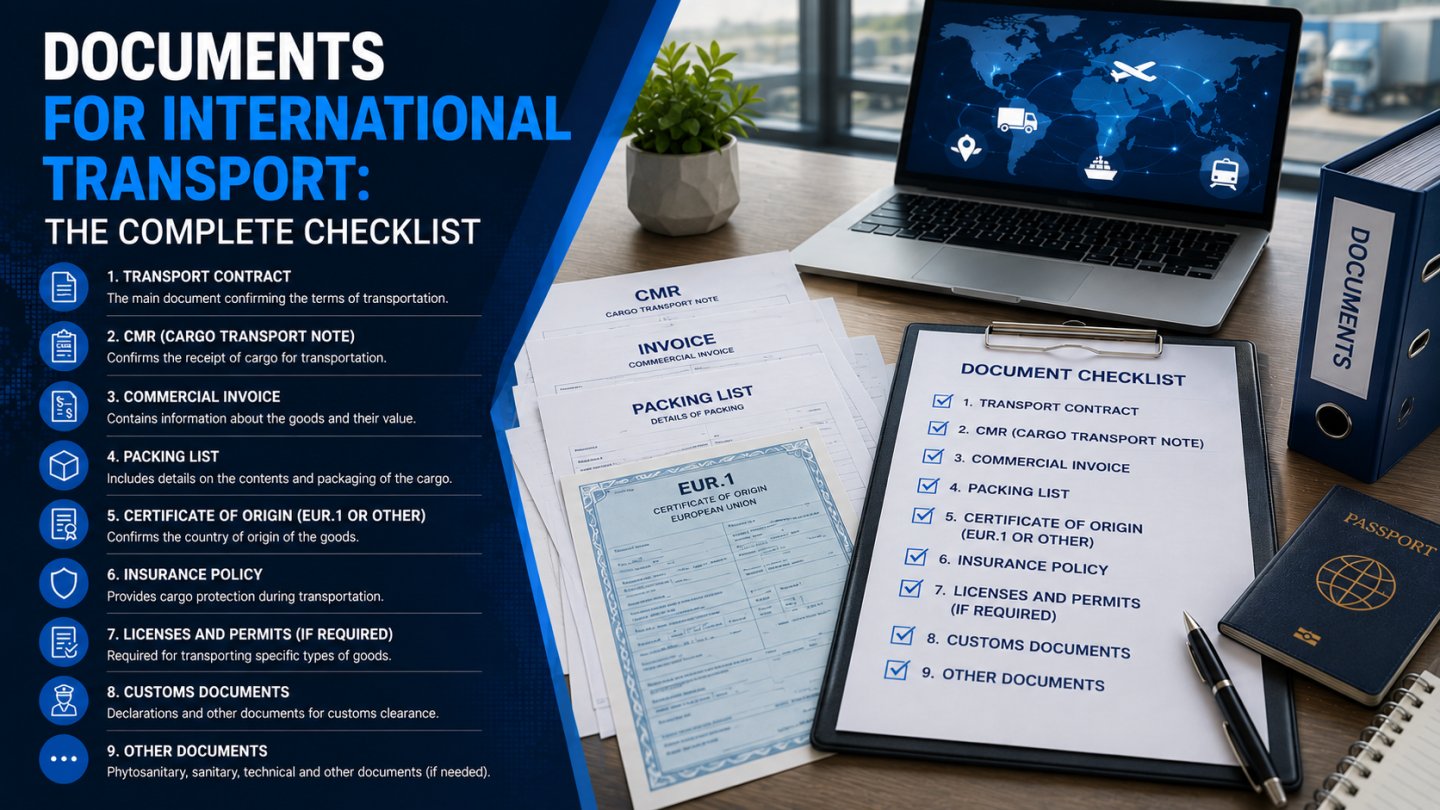
Documents for International Transport: Common Mistakes and the Full List
5 document mistakes that stop cargo at the border
In international logistics, it is the paperwork, not the road, that most often causes delays. Let us start with the main thing — the mistakes we see daily that cost clients a day of downtime:
● Weight mismatch between documents and reality
● Wrong commodity code
● Expired or missing certificates
● Errors in the recipient's data
● Box labelling that does not match the packing list
Common mistake. It's not just first-timers who trip up. Even experienced shippers get confused when a new product type or a new direction with its own rules appears. Support from a carrier that has been through hundreds of cases insures against costly mistakes.
The basic document package
|
Document |
Purpose |
|
CMR waybill |
Confirms the fact and terms of carriage |
|
Invoice |
Value of the goods |
|
Packing List |
Description of contents |
|
Customs declaration |
For clearance |
|
EUR.1 |
Certificate of origin for reduced duty |
|
TIR Carnet |
Simplified transit through several countries |
This is the foundation without which cargo will not move. Each document must line up with the rest. We handle the paperwork for you — part of our documents for transport service.
Over the years we have built an internal document-check list that every shipment passes before departure. This is not bureaucracy but a way to avoid losing a day at the border over a trifle. The experience of thousands of trips taught us: better to spend an hour at the warehouse than a day at the crossing.
Extra documents for specific goods
● Phytosanitary certificate — for plant products
● Veterinary certificate — for animal products
● ADR documents — for dangerous goods
● Licences — for dual-use goods
● EUR.1 — for goods with reduced duty under the EU agreement
Important to know. EU rules are updated, and new certificates and procedures appear. A carrier that clears customs daily tracks these changes first. A leading medical company we serve moves products with strict document requirements, where any inaccuracy is critical.
How to avoid problems
The simplest solution is to hand the paperwork to a carrier that works with customs daily. It helps when they check that packaging and documents match at the warehouse, before loading — so the problem is solved on the spot, not at the border. Across more than 27,000 trips a year we have driven errors to a minimum, and that keeps on-time delivery at 99%. More on international logistics and warehouse services separately.
Pakline experience. In June 2026, a medical distributor trusted us with a batch under strict document and temperature rules. Not a single border query — because the package is checked at the warehouse before departure. See our deep dive on cargo safety; the relevant service is cold-chain logistics.
Finally, a related read worth your time before a first export: how to choose a carrier for your business.
It is also worth remembering that requirements vary by country and even by the specific customs crossing. What works for Poland may need an extra document for Romania. A carrier experienced across directions prepares the package for the specific route from the outset.
FAQ — Frequently Asked Questions
What documents are needed for EU transport?
The basic package: CMR, invoice, Packing List, customs declaration. For some goods — EUR.1, phytosanitary, veterinary certificates, ADR.
What is a TIR Carnet?
It simplifies transit through several countries without a check at every border.
What is EUR.1?
A certificate of origin granting reduced duty under the free-trade agreement with the EU.
Why are ADR documents needed?
For transporting dangerous goods — they confirm approval of the vehicle and driver.
Who is responsible for correct documents?
If the carrier handles the paperwork, they are responsible for the package's correctness and customs clearance.